
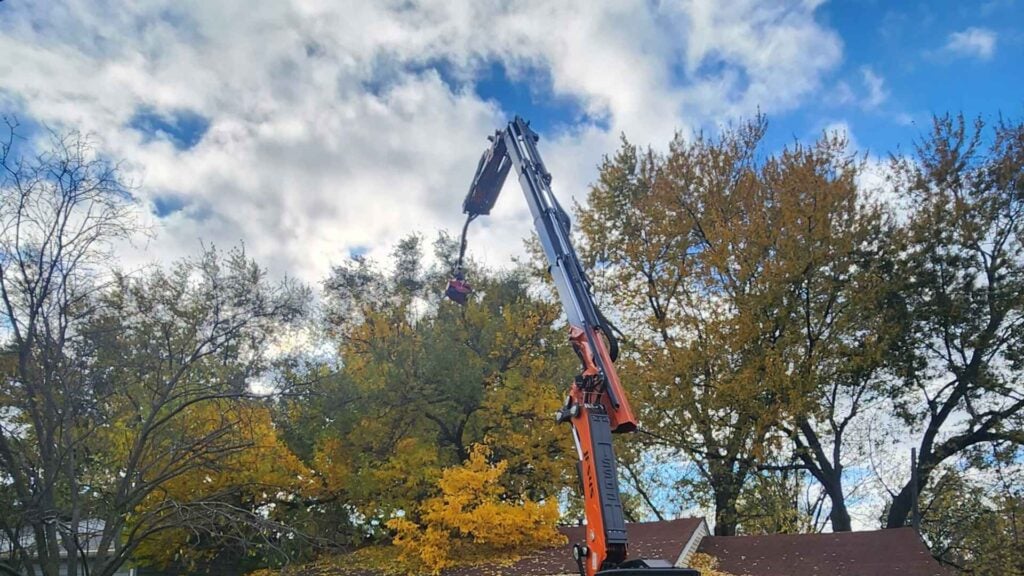
Removing a tree can cost a few hundred dollars or several thousand, depending on what crews are dealing with once they arrive. The biggest influences on tree removal cost in Des Moines include tree size, condition, location, equipment needs, and how difficult the site is to access. A smaller tree in an open yard is usually straightforward. A mature tree hanging over a roof is a different project entirely. Understanding those differences makes it easier to budget, compare quotes, and know what you are actually paying for.
Central Tree Pros, which handles tree removal across the Des Moines metro, talked through what separates a well-run removal from a cheap one in Episode 2 of The Sawdust Sessions, with owner and CEO Zach Miller and Operations Manager Jack Wadden. The pricing factors below apply across the metro, from Des Moines itself to West Des Moines, Ankeny and Urbandale.
How Much Does Tree Removal Cost in Des Moines?
Professional tree removal commonly costs about $200 to $2,000, according to HomeAdvisor’s national estimate, which puts the average at about $750, and especially large or complicated removals can cost more. There is no single price that applies to every tree.
Those figures are useful as a starting point, but they should not be treated as a guaranteed Des Moines quote. The tree and property have to be evaluated together.
A practical way to think about pricing is:
- Small tree (lower cost level): shorter height, open area, easy access.
- Medium tree (moderate cost level): more wood, climbing, rigging, and hauling.
- Large mature tree (higher cost level): heavy limbs, larger trunk, more equipment.
- Hazardous or complex tree (highest cost level): structures, utilities, storm damage, restricted access.
Tree height alone does not tell the whole story. A tall tree growing in the middle of a large open lot may be simpler to remove than a shorter tree squeezed between a garage, fence, and neighboring property.
That is why an on-site estimate is usually much more meaningful than an online price calculator.
What Factors Affect Tree Removal Prices?
Several conditions determine how much labor, equipment, and planning a removal requires. In many cases, risk and access matter just as much as the tree’s actual size.
Tree Height and Trunk Diameter
Larger trees contain more wood, which means more cutting, lowering, chipping, and hauling. A wide trunk also takes longer to section into manageable pieces.
Height becomes especially important when crews cannot safely drop large sections. Instead, branches and trunk sections may need to be lowered individually with ropes and rigging.
Large mature hardwoods can also produce extremely heavy sections of wood, requiring additional equipment and careful handling.
Tree Condition
A healthy tree is not necessarily easy to remove, but its wood and branch structure may be more predictable than those of a badly deteriorated tree.
Dead, decaying, split, hollow, or storm-damaged trees can create additional hazards. Branches may break unexpectedly, and compromised trunks may no longer support a climber safely.
Iowa State University Extension advises that trees with split trunks, extensive trunk damage, major canopy loss, or partial uprooting may require removal. It also recommends professional evaluation when homeowners are uncertain about the extent of structural damage.
That added uncertainty can require lifts, cranes, additional rigging, or another removal approach.
Location and Accessibility
Two nearly identical trees can have very different prices because of where they are growing.
A tree next to a driveway may provide easy access for trucks, chippers, and other equipment. A backyard tree behind a six-foot privacy fence may require much more manual work.
Common obstacles include:
- Narrow gates
- Fences
- Garages
- Sheds
- Pools
- Retaining walls
- Landscaping
- Septic areas
- Neighboring homes
If logs and branches cannot be moved directly to equipment, crews may have to carry or transport them in smaller sections. That increases labor time.
Buildings and Power Lines
A tree growing over a roof cannot usually be handled the same way as one standing in an open yard.
Crews may need to lower each limb into a controlled drop zone rather than allowing material to fall freely. Nearby power lines add another major concern.
OSHA identifies falling objects, falls from elevation, chainsaw injuries, and contact with energized power lines as serious hazards in tree-care and removal work.
More hazards generally mean more planning, equipment, and crew time.
Does the Type of Tree Affect Removal Price?
Tree species can influence removal difficulty because different trees have different wood densities, growth habits, branch structures, and mature sizes.
Des Moines properties may have mature oaks, maples, elms, ash, cottonwoods, locusts, and other large shade trees. A dense hardwood can create heavier trunk and limb sections than a similarly sized tree with lighter wood.
Wide crowns also matter. A mature tree with long branches extending over several parts of the property may require considerably more rigging than a narrow tree of similar height.
Multi-stem trees present another challenge because each trunk has to be evaluated separately.
Species can also affect structural condition. Iowa State University notes that ash trees killed by emerald ash borer become increasingly brittle as they decline, which can make falling limbs and structural failure a concern.
The name of the tree does not determine the bill by itself, but its characteristics can affect how the removal must be performed.
Why Does Emergency Tree Removal Cost More?
Emergency removal often costs more because crews may be responding to an immediate hazard rather than a normal scheduled job.
After severe wind or thunderstorms, trees may split, lean, uproot, or drop large limbs. A damaged tree can also end up resting against a house or suspended in another tree.
Typical emergencies include:
- Trees on homes or garages
- Trees blocking driveways
- Hanging or broken limbs
- Split trunks
- Partially uprooted trees
- Trees that suddenly lean toward structures
- Storm damage near utilities
These situations may require rapid scheduling, larger crews, specialized equipment, or additional safety precautions.
Iowa State University recommends checking storm-damaged trees for broken or hanging limbs and warns homeowners against attempting hazardous chainsaw work without the proper experience.
A tree that simply needs removal someday is different from one that could come down on a house tonight. The level of urgency affects how the job is planned and priced.
Is Stump Grinding Included in Tree Removal?
Cutting a tree down and removing its above-ground sections may be priced separately from dealing with the stump.
Stump grinding uses specialized equipment to reduce the remaining stump below ground level. It is commonly chosen when homeowners want to restore the area with soil, grass, or landscaping.
Full stump removal is more extensive because it involves removing a larger portion of the stump and root system. That can disturb significantly more soil and may not be necessary for every property.
The price of stump work can depend on:
- Stump diameter
- Root flare
- Number of stumps
- Equipment access
- Nearby utilities
- Sidewalks or hardscaping
- Cleanup requirements
Homeowners should also ask what happens to the resulting wood chips. Some contractors leave grindings on site, while others may include hauling them away.
Before accepting an estimate, confirm whether stump grinding is included or listed as an optional service.
What Other Charges Can Be Added to a Tree Removal Estimate?
The price to cut the tree is not always the entire project price.
Depending on how a company structures its estimates, additional services may include:
- Brush removal
- Log hauling
- Wood chipping
- Stump grinding
- Crane service
- Aerial lift use
- Difficult-access equipment
- Emergency scheduling
- Extensive cleanup
This does not necessarily mean a contractor is adding unexpected fees. Some companies bundle these items into one price, while others list them individually.
The important part is understanding the scope.
Ask whether the quoted price includes removing the entire tree, hauling debris, cleaning the work area, and handling the stump. Comparing two numbers without comparing what is included can make one estimate appear cheaper even though it covers considerably less work.
Can Homeowners Insurance Pay for Tree Removal?
Sometimes. Coverage generally depends on why the tree fell, whether it damaged covered property, and the language in your individual policy.
A tree brought down by a covered storm that damages a house may be treated differently from a tree that simply falls in the middle of the yard.
The Insurance Information Institute explains that homeowners insurance may cover damage when a tree falls on an insured structure, while removal of a tree that falls without damaging covered property may not be handled the same way.
Policy limits and deductibles can also affect what the homeowner ultimately pays.
After storm damage, take photos before cleanup when it is safe to do so. Keep invoices and other documentation related to the work. For questions about reimbursement, contact your insurer or agent rather than assuming the entire removal will be covered.
Why Can Two Tree Removal Quotes Be So Different?
Two companies can inspect the same tree and come back with different prices because they may be planning different ways to complete the work.
One crew may use a crane while another intends to climb and rig the tree. One estimate might include hauling every log away, while another leaves large wood sections on the property.
Equipment, crew size, insurance, access plans, and cleanup can all influence the total.
The lowest estimate is therefore not automatically the best value.
Zach Miller made the same point on the episode, because an insured crew costs more to run: “When we’re paying to insure seven or eight guys on a job site, that does come with a cost. Our estimates aren’t going to be as cheap as some, but you’re getting more value than you are saving money.”
Compare the scope of work carefully. Look at how the tree will be removed, what equipment will be used, what cleanup is included, and whether stump work is part of the agreement.
The International Society of Arboriculture recommends hiring qualified tree-care professionals for work involving large trees and other situations where safety and proper technique are important.
What Should You Ask Before Hiring a Tree Removal Company?
A written estimate should tell you more than the final price.
Before hiring someone, ask:
- Is your company insured?
- What work is included in this price?
- Is hauling and cleanup included?
- Is stump grinding included?
- Will you use a crane, lift, or other large equipment?
- How will you protect my driveway, lawn, and landscaping?
- How will you work around nearby structures?
- What happens if you discover additional hazards?
The answers make it easier to compare proposals fairly. Our guide to telling whether a tree company is qualified and insured covers the insurance questions in more detail.
You should also make sure the crew understands access restrictions before work begins. Gates, parked vehicles, overhead utilities, fences, and neighboring properties can all affect how equipment reaches the tree.
When comparing tree removal cost estimates in Des Moines, focus on the work being performed and the risks being managed, not just the number at the bottom of the page.
Get a Clear Answer About What Your Tree Will Cost to Remove
A tree leaning toward your house, dropping large limbs, or simply growing too large for its location can leave you with two frustrating questions: Does it actually need to come down, and how much is removal going to cost?
Online averages can help you plan, but they cannot account for the exact size, condition, access, nearby structures, or hazards on your property.
Central Tree Pros can evaluate the situation and explain what the job actually involves. That gives you a clearer idea of the equipment, removal process, cleanup needs, and expected cost before work begins.
If you have a tree in the Des Moines area that may need to come down, contact Central Tree Pros to schedule an assessment and get an estimate based on your property.
Frequently Asked Questions About Tree Removal in Des Moines
How Much Does Tree Removal Cost in Des Moines?
Most tree removals cost about $200 to $2,000 by HomeAdvisor’s national estimate, and a Des Moines quote depends on the tree’s size, condition, access, and nearby structures, which is why an on-site estimate matters more than an online average.
What Time of Year Is Cheapest for Tree Removal?
There is no guaranteed cheapest season. Pricing depends on demand, weather, tree condition, and scheduling. A non-emergency removal may offer more flexibility than waiting until a damaged tree requires immediate attention.
Can I Save Money by Keeping the Firewood?
Possibly. Ask whether leaving usable logs on the property changes hauling or disposal costs. The amount saved depends on the tree, how much wood is involved, and the company’s pricing structure.
Can Several Trees Be Removed During the Same Visit?
Yes. Removing multiple trees during one project can sometimes improve efficiency because the crew and equipment are already on site. Each tree still has to be priced according to its size, condition, and difficulty.
How Long Does Tree Removal Usually Take?
A straightforward tree may be completed within part of a day. Large or complicated removals can take longer, particularly when crews need extensive rigging, cranes, restricted-access equipment, or careful work around structures. Zach Miller says Central Tree Pros crews are typically on site no more than one day once a removal starts.
Do I Need to Be Home During Tree Removal?
Not always. Requirements vary by company. The crew should have clear access to the work area and an agreed scope before starting. Any locked gates, vehicles, pets, or access concerns should be handled beforehand.
What Happens to the Branches After Removal?
Branches are commonly fed through a chipper, while larger trunk sections may be hauled away or cut into manageable logs. Ask whether all debris removal is included in your estimate. Central Tree Pros has moved away from chippers and loads brush with a debris truck and claw instead, according to Zach Miller.
Will Tree Removal Damage My Lawn?
Heavy equipment can affect turf, especially when soil is soft. Access planning, careful machine placement, and protective ground mats can help reduce lawn damage, although some disturbance may be unavoidable on difficult removals.