
For most Iowa homeowners, the best time to trim trees is the late dormant season, February through March, when branches are easier to inspect and trees are preparing for spring growth. Oaks are the exception and are best pruned from December through February. Knowing when to prune can make the difference between helping a tree and putting it under unnecessary stress.
This guide draws on Episode 4 of The Sawdust Sessions with Zach Miller, owner and CEO of Central Tree Pros, and operations manager Jack Wadden. Central Tree Pros is a tree service based in Des Moines that handles tree trimming and pruning across the metro, including West Des Moines, Ankeny and Urbandale.
However, timing can change depending on the species, tree condition, weather, and reason for pruning. This guide explains how each season affects tree care, when damaged limbs should come down immediately, and how to make safer decisions for your property.
Why Does Tree-Trimming Timing Matter?
Timing matters because the same cut can help a tree in one season and stress it in another. Pruning is more than cutting branches to improve appearance. Done correctly, it can improve structure, remove hazards, provide clearance, and guide healthy growth. Done at the wrong time or too aggressively, it can create unnecessary stress.
During dormancy, deciduous trees have no leaves, which makes crossing limbs, weak attachments, deadwood, and competing leaders easier to identify. According to Iowa State University Extension and Outreach, February through March is generally a good time to prune most deciduous trees in Iowa.
That does not mean every tree should automatically be pruned during those months. Species, age, health, and safety concerns all matter.
What Is the Difference Between Trimming and Pruning?
Pruning is for the tree’s health and trimming is for its looks and clearance, Jack Wadden explained on the episode: trimming lifts branches so you can mow underneath or pulls limbs back from the house, while pruning takes out deadwood and branches that grow into other branches.
Zach Miller drew the line simply: “Anything that makes the tree healthier is pruning. Anything that’s more of a luxury is trimming.” He added, “If you’re properly pruning, you’ll really never have to trim your tree.”
When you hire a crew, see what to look for in the best tree trimming service in the Des Moines metro.
What Is the Ideal Season for Tree Trimming?
For many deciduous trees in Iowa, late winter is a practical time for routine pruning. Trees are dormant, branch structure is visible, and there is less foliage to work around.
Why Does Late Winter Often Work Well?
Without leaves, it is easier to follow branches to their attachment points and decide which cuts are necessary. The focus can stay on deadwood, weak branch relationships, clearance issues, and long-term structure instead of simply thinning a canopy because it looks dense.
Can You Prune in Early Spring?
Some pruning can continue into early spring before buds fully open. Once active growth begins, the decision becomes more species-specific.
Spring is also when homeowners often notice winter damage. A cracked or broken branch should be evaluated based on safety and tree health rather than delayed simply because the ideal dormant window is ending.
Leaf-out also shows where the dead wood is. As a tree starts to bloom, Jack Wadden said, “some parts are starting to get leaves and some parts are not,” so dead branches are easy to find.
Is Summer a Good Time to Trim Trees?
Summer works for lighter jobs, such as minor corrective work and the removal of dead, damaged, or hazardous branches. Iowa State University Extension and Outreach also names early summer, late May to mid-June, as an acceptable time to prune most deciduous trees.
However, heavy pruning during hot or dry weather may add stress. Removing too much healthy foliage reduces the leaf area the tree uses to produce energy. Major canopy reduction should not be treated as routine summer maintenance.
Summer can also be a poor time for certain species because fresh wounds may increase exposure to pests or disease. Oaks are especially important in Iowa because of oak wilt risk.
Should You Trim Trees in the Fall?
Fall is usually not the first choice for major pruning of most deciduous trees. Trees are shifting toward dormancy, and routine structural pruning can often wait until leaves have dropped.
Safety problems are different. A cracked limb hanging over a driveway does not become less dangerous because it is October. Dead, broken, or unstable branches may need attention regardless of season.
Fall is still a good time to call, because the crew “will tell you what kind of tree you have and when the best time to do it is,” as host Mike Downer put it on the episode.
When Should a Tree Be Trimmed Immediately?
Trim right away, whatever the season, when a branch creates an immediate hazard. Prompt evaluation makes sense when you notice:
- Broken or hanging limbs
- Large dead branches over driveways, sidewalks, patios, or play areas
- Cracks where major limbs connect to the trunk
- Branches damaged by wind, ice, or storms
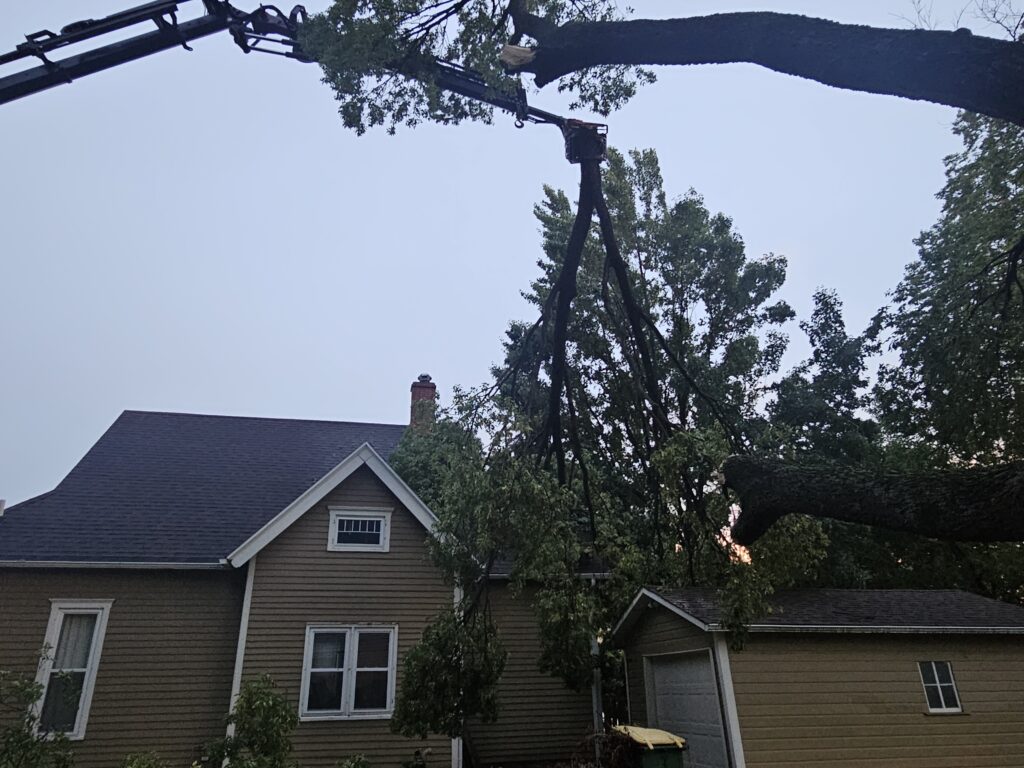
- Limbs resting on or pressing against a structure
- Sudden leaning or visible structural changes
- Branches interfering with safe access or visibility
Storm damage deserves particular caution. A partially broken limb can remain caught in the canopy and look stable from the ground even after its attachment has failed.
If the work requires climbing, a chainsaw, rigging, or working near structures or utilities, professional help is the safer option.
Does Timing Depend on the Type of Tree?
Yes. Different trees grow, flower, and respond to pruning differently. A schedule that works for one species may be inappropriate for another.
Mature Shade Trees
Mature trees usually benefit from selective pruning instead of aggressive canopy removal. The goal may be to remove deadwood, improve clearance, or address weak branch relationships.
Young Trees
Young trees offer an opportunity to correct structural issues before they become larger problems. Early pruning can address competing leaders, poorly placed limbs, or branches likely to create future conflicts.
For newly planted trees, pruning is generally limited to dead, damaged, or problematic branches while the tree establishes.
Flowering and Fruit Trees
Flowering trees may need more careful timing because pruning can remove flower buds. Some species bloom on older wood, while others flower on new growth.
Fruit trees also have specific goals related to structure, sunlight, airflow, and production. Removing the wrong branches at the wrong time can affect both form and fruiting.
Evergreen Trees
Pines, spruces, and firs do not always follow the same rules as deciduous trees. Dead or broken branches can often be removed as needed, but shaping and growth control depend on the species.
Why Do Oak Trees Need Special Attention in Iowa?
Oaks need their own timing because pruning wounds made in warm months can let in oak wilt, a fungal disease that is lethal to many oaks.
Iowa State University Extension and Outreach recommends pruning Iowa oaks during winter, especially December through February, to reduce the risk of oak wilt. The disease can spread when sap-feeding beetles carry fungal spores to fresh wounds.
Jack Wadden gave the same advice from the field: “An oak tree, for example, should be trimmed during winter when it goes dormant.”
That is why routine oak pruning should not be scheduled casually during warmer months. If storm damage makes pruning unavoidable during the growing season, species-specific precautions may be necessary.
How Often Should Trees Be Trimmed?
There is no universal schedule that says every tree needs pruning once a year or every few years.
Frequency depends on age, species, growth rate, structure, location, and condition. A young tree being trained for good structure may need more frequent attention than a mature tree with a stable canopy.
Instead of pruning by calendar alone, look for a reason. Deadwood, rubbing branches, weak attachments, poor clearance, storm damage, or developing structural problems are better indicators.
Regular care keeps each visit smaller. Zach Miller compared it to a lawn: “If you don’t mow your grass for six months, it’s going to take a lot more work and be a lot more expensive.”
Routine inspections can also reveal issues before they become urgent, especially for mature trees near homes, driveways, and sidewalks.
How Does Iowa Weather Change Tree-Trimming Decisions?
Iowa weather can quickly turn a routine maintenance question into a safety concern.
Winter snow and ice can load branches until they crack. Spring and summer storms can produce high winds that break limbs or expose weak attachments. Heat and drought can add stress.
After a major storm, inspect trees from a safe distance. Look for hanging limbs, fresh cracks, split branches, broken tops, or pieces caught in the canopy.
Not every damaged tree needs removal. Some can recover with selective pruning and proper care. The first step is understanding how severe the damage is and whether the remaining structure is stable.
What Are the Signs a Tree Needs Trimming?
Common warning signs include dead branches, rubbing limbs, hanging branches, cracks, low limbs blocking access, and growth pressing toward roofs or siding. Multiple stems with weak unions can also deserve closer evaluation.
A tree does not need to look overgrown to need attention. Structural and safety problems can develop long before the canopy looks messy.
What Tree-Trimming Mistakes Should Homeowners Avoid?
One of the biggest mistakes is removing too much canopy at once. Excessive pruning can stress a tree and encourage weak, rapid regrowth.
Jack Wadden explained the risk on the episode: cut too much off and “it’ll go into shock,” and a cut that is not made properly “will hold water and start rotting that section of the tree.”
Topping is another damaging practice. Cutting major branches back to stubs changes the tree’s natural structure and can lead to weakly attached shoots. University of Minnesota Extension recommends avoiding topping and preserving a tree’s natural structure whenever possible.
Jack also called topping a tree “about the worst thing you can possibly do for it.”
Homeowners should also avoid using ladders and chainsaws for work beyond their experience, especially when large limbs or power lines are involved.
Another mistake is trimming simply because a tree looks full. A dense canopy does not automatically mean large amounts of healthy growth need to be removed.
Can You Trim Trees Yourself?
Small branches that can be reached safely from the ground may be manageable for some homeowners with proper tools and basic pruning knowledge.
Professional help makes more sense when branches are large, elevated, storm-damaged, near structures, or close to utility lines. The same applies when you cannot clearly identify which branches should be removed.
A good pruning plan is selective. The goal is not to cut as much as possible. It is to make the right cuts for safety, structure, clearance, and long-term tree health.
If the job requires climbing, rigging, chainsaw work at height, or controlling the fall of heavy limbs, the risks increase quickly.
How Do Professionals Decide When and What to Trim?
A tree professional looks beyond the season. Species, age, condition, branch structure, deadwood, previous pruning, nearby structures, and signs of decay all help determine the next step.
The reason for pruning also changes the plan. A young tree being trained for structure has different needs than a mature tree with storm damage. A branch growing toward a roof presents a different challenge than a dead limb over a driveway.
That broader assessment helps create a plan based on the tree, the property, and the homeowner’s goals rather than a one-size-fits-all schedule.
Is the Season the Only Thing That Matters?
No, the season is only part of the decision. For many deciduous trees in Iowa, late winter offers a practical pruning window, but timing should never be separated from species, condition, and safety. Oaks need special consideration because of oak wilt, while storm-damaged branches may require action regardless of the month.
Ultimately, the best time to trim trees depends on what is growing on your property, what condition it is in, and what you are trying to accomplish. Good tree care starts with understanding those factors before making the first cut.
Frequently Asked Questions
When Is the Best Time to Trim Trees in Iowa?
For most deciduous trees, the best time to trim trees in Iowa is the late dormant season, February through March, when trees are dormant and their branch structure is easy to see. Oaks are generally best pruned from December through February.
Is Winter a Good Time to Prune Trees?
Yes. Winter is often a good time for structural pruning because deciduous trees are dormant and have no leaves. Exact timing still depends on species, condition, and weather.
Can Trees Be Trimmed During Summer?
Yes, especially when removing dead, broken, or hazardous branches. However, major pruning during hot or dry periods may place unnecessary stress on some trees.
Should Dead Branches Be Removed Immediately?
Dead branches can often be removed when identified, particularly if they could fall onto people, vehicles, buildings, or walkways. Large or elevated deadwood should be handled professionally.
Why Should Oaks Be Pruned in Winter?
Winter pruning reduces the chance that fresh wounds will attract beetles capable of spreading the fungus that causes oak wilt.
How Often Should Mature Trees Be Trimmed?
There is no fixed schedule for every mature tree. Pruning should be based on deadwood, structure, clearance, growth, storm damage, and overall condition.
Can Pruning at the Wrong Time Harm a Tree?
Yes. Poor timing can increase stress, remove flower buds, expose certain species to disease risk, or interfere with growth. The amount removed and quality of the cuts also matter.
When Should I Call a Professional Tree Service?
Call a professional when pruning involves large limbs, climbing, storm damage, structural defects, nearby buildings, utility lines, or uncertainty about the tree’s condition.
Does Central Tree Pros Trim Trees Outside Des Moines?
Yes. Central Tree Pros is based in Des Moines and trims trees across the metro, including West Des Moines, Ankeny and Urbandale.
Not Sure Whether Your Trees Should Be Trimmed Now or Later?
Have a professional look before anyone cuts. It is common to notice a questionable branch and wonder whether it needs attention now or can safely wait. Maybe limbs are getting close to your roof, the canopy looks crowded, or a recent storm left branches in places they were not before.
You should not have to guess.
Central Tree Pros can evaluate your trees, identify structural or safety concerns, and help determine the right next step for your property. Whether your trees need routine pruning, storm-damage cleanup, or a professional assessment, the goal is to make informed decisions that protect your trees, your home, and the people around them.
To have your trees looked at, request an estimate from Central Tree Pros.