
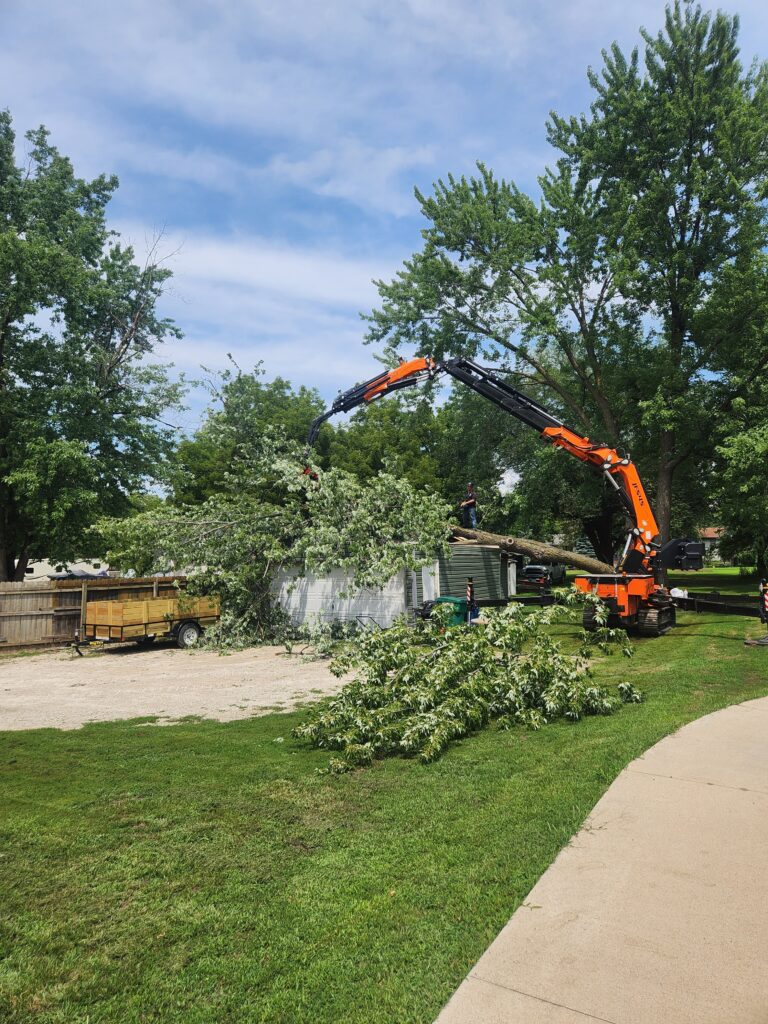
Crane tree removal cost depends on the tree, the access and the equipment the job needs, and national estimates put crane assistance alone at $500 to $2,500 on top of the removal. A large tree hanging over your roof can make even a routine removal feel stressful. You want the hazard gone, but you also want to know whether a crane is necessary and what the work might cost. Access, structural condition, nearby buildings and cleanup all shape the final estimate. Understanding those factors can help you compare quotes, avoid surprises and choose a removal plan that protects your property without paying for work you do not need.
Central Tree Pros is a Des Moines tree service that owns its cranes and handles crane tree removal across the metro, including Ankeny, Urbandale and West Des Moines. On Episode 5 of The Sawdust Sessions, owner and CEO Zach Miller and operations manager Jack Wadden explained how they decide when a crane comes out, and their answers run through this guide.
How Much Does Crane-Assisted Tree Removal Cost?
Crane-assisted tree removal has no reliable flat rate, but national estimates give a starting range. Cost Home Book, a residential cost reference updated September 29, 2026, puts crane assistance at $500 to $2,500 on top of the removal itself, and removing a tree over 100 feet tall at $2,500 to $8,000. These are national estimates, not Central Tree Pros quotes.
An estimate for a healthy tree beside an open driveway will look different from one for a storm-damaged tree leaning over a house. The same source adds 30% to 100% when a tree over a house has to be rigged down in pieces.
Some advertised prices cover only crane rental, not cutting, lifting, debris handling and cleanup.
Ask for a site-specific, written estimate explaining the equipment, work and included services. That is more useful than an advertised starting price.
What Should a Removal Estimate Include?
A complete crane-assisted removal quote may account for equipment and an operator, a tree crew, site protection, controlled lifting, wood processing and debris haul-away. It should also identify exclusions. Stump grinding, landscape restoration and emergency charges may be priced separately.
At Central Tree Pros, estimates are free, written and carry no obligation, so you can see what is included before work begins.
What Affects the Price of Crane Tree Removal?
Size, access, the tree’s condition and the equipment needed set the price, which is why similar-sized trees can require very different removal plans. Contractors evaluate the tree and its surroundings before pricing the work.
Tree Height, Diameter, and Branch Spread
Tall trees usually require more cutting and lifting. However, height alone does not tell the whole story. A thick trunk, broad canopy or heavy limbs can increase the number of sections that must be removed.
Wood species and moisture also affect weight. Crews must consider the expected weight of each section rather than assume that a crane can lift an entire tree in one piece. Controlled lifts may be necessary.
Access for the Crane and Ground Crew
The crane needs a suitable place to set up, not merely a route into the neighborhood. Narrow driveways, fences, soft ground, retaining walls and landscaping can restrict positioning. Street setup may be possible.
Reach matters, too. Greater reach can reduce the crane’s permitted lifting capacity. Limited access may require extra cuts or equipment.
Location can matter more than size. Miller says that when a tree stands in a backyard no other equipment can reach, the access drives the plan, and the crane can set up outside the fence and reach over.
Tree Health and Stability
A dead, hollow, split or storm-damaged tree can behave unpredictably during removal. It may be unsafe for a worker to climb or unsuitable for conventional rigging. Crane assistance can make controlled lifting possible, but it does not eliminate the need to assess the tree carefully.
The Occupational Safety and Health Administration identifies falls, falling objects and electrical contact among tree-care hazards. Those risks help explain why qualified workers, planning and proper equipment are part of the price.
Equipment and Crew Requirements
Some removals need a knuckleboom crane, while others call for a stick crane or a different lifting setup. Selection depends on reach, load and access.
Operators and ground crews must coordinate every cut and lift. If a company rents a crane from another provider, scheduling and separate charges may affect the quote. Central Tree Pros owns and operates its knuckleboom and stick cranes in-house, so one team coordinates complex jobs from start to finish.
Ownership shows up in how often a crane comes out. Miller says the crew brings a crane in on at least 98% of its removals, because “we are not paying rental fees to bring someone else’s crane in,” and Wadden adds that there is no set price point that decides when the crane comes.
When Does a Tree Actually Need a Crane?
A tree needs a crane when climbing it or dropping sections would put people or property at unacceptable risk. Height alone does not make a crane necessary.
Consider a mature tree whose limbs extend across a garage roof. There may be no clear area where branches can fall. A crane can support planned sections and move them toward a designated landing area, so the crew does not have to lower everything through a narrow space.
Storm damage presents another challenge. Split trunks and suspended limbs can shift without warning. A trained crew may use crane assistance to manage sections that would be hazardous to access by climbing.
Backyard removals also qualify when trees stand between houses, decks, fences and landscaping. Crane reach may allow the crew to work from a suitable setup location outside the tightest area.
An on-site assessment is still essential. Sometimes careful rope rigging or an aerial lift is enough, and choosing that method can avoid equipment you do not need. For the full method, see how crane-assisted tree removal works.
Is Crane Removal Cheaper Than Traditional Tree Removal?
Sometimes, because a crane can replace days of climbing and rigging with hours of controlled lifting, though the right method depends on the site. The goal is to choose the approach that safely handles the tree and its surroundings, not to use the biggest machine available.
Traditional Climbing and Rigging
With conventional sectional removal, trained workers climb or use an aerial lift, cut branches and trunk sections, and lower them with ropes or other approved equipment. This can work well when the tree is stable and a suitable landing zone is available.
However, lowering every piece through a crowded yard may require extensive rigging and ground labor. An unstable tree may also rule out climbing altogether.
Crane-Assisted Lifting
Crane-assisted work uses lifting equipment to hold and move selected tree sections under a planned sequence. This limits lowering heavy wood around obstacles.
Crane use introduces its own risks, including ground loading and lifting limits. Professional setup, communication and equipment inspections remain critical. No method can promise that a property will never see incidental disturbance.
Comparing Total Value
A crane adds specialized equipment to the job, yet it can reduce the number of hours needed for complex rigging. On some sites, that makes the overall removal competitive with traditional methods.
On one Central Tree Pros job, two cottonwoods at least 150 feet tall stood on either side of a home. The crew finished in about six hours with two cranes, where the other bids planned three or four days of climbing and roping, and Miller says the price came in “right in the middle” of the bids.
Compare the complete scope instead of the headline figure. A higher quote that covers equipment, insurance, cleanup and responsibilities can provide better value.
What Happens on Removal Day?
Most crane-assisted removals follow the same three stages: inspection and setup, controlled cutting and lifting, and cleanup.
Inspection and Site Preparation
The crew confirms the tree’s condition, equipment placement, ground stability and surrounding obstacles. They establish work zones and review communication and lifting plans. Vehicles or outdoor furniture may need to be moved before setup.
At Central Tree Pros, Wadden says the day starts at the shop with a safety meeting, a check that the crane is running right and a walk-through so every crew member knows their role.
If branches are near electrical lines, the contractor must assess the hazard and coordinate with the utility when necessary. Homeowners should never touch a tree or branch in contact with a power line.
Controlled Cutting and Lifting
The crane is positioned and stabilized according to its operating requirements. Workers then remove sections in a planned order, using the appropriate equipment for each lift.
The pieces travel to a designated processing area. Branches may be chipped, and larger trunk sections can be cut down for hauling. Keeping people away from the work zone is part of the operation.
Cleanup and Final Walkthrough
After the tree is down, the crew removes wood and debris according to the agreement. The homeowner can confirm what was completed, what remains and whether any separate stump work is scheduled.
What Extra Costs Can Change a Crane Removal Quote?
Stump grinding, emergency timing, debris hauling, permits and site repairs are the usual extras, so check whether your proposal includes them:
- Stump grinding: The stump and surface roots may remain after the tree is removed. Grinding is usually a separate service.
- Emergency response: Storm damage, urgent hazards and after-hours work may change scheduling and pricing.
- Debris removal: Confirm whether branches, logs, chips and oversized wood will be hauled away or left on site.
- Permits and access: Local requirements, traffic control or unusual equipment access may add work.
- Site repairs: Lawn, driveway, fence or landscaping restoration should be discussed before equipment arrives.
Written details prevent misunderstandings. A quote for taking down a tree is not necessarily a quote for restoring the entire yard afterward.
How Do You Get an Accurate Crane Removal Estimate?
Start with a site visit, because photos can hide decay, ground conditions and equipment access problems.
Ask the company to assess tree size, stability, access, nearby structures and the expected removal process. Then request a written scope showing what happens to the trunk, limbs, debris and stump.
Questions Worth Asking Before You Hire
Ask whether the company owns its crane or uses a subcontractor. Confirm the operator’s qualifications and the crew’s experience with removals near buildings. Request proof of liability and workers’ compensation insurance, including coverage appropriate to crane work.
Also ask where the crane will sit, how surfaces will be protected and who handles unexpected damage. Confirm the cleanup plan, any separate stump charges and how changes to the price will be approved. Our guide to what to look for when hiring a tree crane service covers these questions in more depth.
The International Society of Arboriculture emphasizes hiring trained professionals for dangerous tree work. Credentials, insurance, clear specifications and relevant experience matter more than a low number alone.
How Can You Keep Crane Removal Costs Down Safely?
Plan early, compare itemized quotes for the same scope, and never cut or climb a compromised tree yourself. If removal is not an emergency, schedule an assessment before the tree deteriorates further. Planning gives you more room to compare methods and prepare the site. You can also ask whether moving vehicles or clearing easy obstacles will improve access, but leave anything dangerous to the crew.
Compare itemized quotes for the same scope. One contractor may include hauling while another leaves the logs behind. If an unexpected hazard strains your budget, ask about financing, which Central Tree Pros offers through Wisetack.
Understanding crane tree removal cost means looking beyond equipment fees to the full work plan, safety precautions and the condition of your property after the job. A clear estimate helps you make a safer financial decision.
Get a Clear Plan and a Free Estimate From Central Tree Pros
Finding a dangerous tree close to your home is stressful enough without wondering whether the price will change halfway through the job. You deserve an explanation of what needs to happen, why a crane may help and what the work will include.
At Central Tree Pros, we own and operate our cranes, so you are working with one team on complicated removals. We provide free, written, no-obligation estimates and handle tree removal with cleanup. If a storm has created an urgent hazard, our emergency team is available 24/7.
Tell us what is happening on your property. We’ll assess the situation, explain the options and help you choose a sensible next step. Request a free crane removal estimate from Central Tree Pros in Des Moines and Central Iowa.
Frequently Asked Questions
How Much Does Crane Tree Removal Cost?
There is no flat rate. National estimates put crane assistance at $500 to $2,500 on top of the removal, and removing a tree over 100 feet tall at $2,500 to $8,000, so a site visit sets the real price.
Is Crane Removal Always More Expensive Than Regular Tree Removal?
No. Equipment can raise upfront expenses, but crane assistance may reduce labor and rigging time on a difficult job. The most economical safe method depends on the site.
How Long Does Crane-Assisted Tree Removal Take?
Some removals can be completed in a day. Central Tree Pros removed two cottonwoods at least 150 feet tall in about six hours with two cranes, while very large trees, difficult access, weather or cleanup can extend a project.
Can a Crane Remove a Tree Close to My House?
Often, yes. Cranes can lift planned sections away from roofs and nearby structures when setup and reach allow. A site inspection determines whether that approach is appropriate.
Does Homeowners Insurance Pay for Crane Tree Removal?
It depends on the cause of the loss and your policy. The Insurance Information Institute says that when a tree hits an insured structure, a homeowners policy generally covers removal up to about $500 to $1,000, depending on the insurer and policy, while removing a tree that hit nothing is generally not covered.
Can You Use a Crane on a Dead or Storm-Damaged Tree?
Yes, in appropriate conditions. Cranes can help handle unstable sections without relying on climbing, but the crew must evaluate the tree and plan each lift carefully.
Will Heavy Equipment Damage My Lawn or Driveway?
Equipment can affect soft ground or paved surfaces. Proper setup and protective measures help manage that risk, so discuss equipment placement and responsibility for any damage beforehand.
Is Stump Grinding Included With Crane Removal?
Not automatically. Some companies quote stump work separately from cutting and hauling, so ask for both services to be identified clearly in the written estimate.