
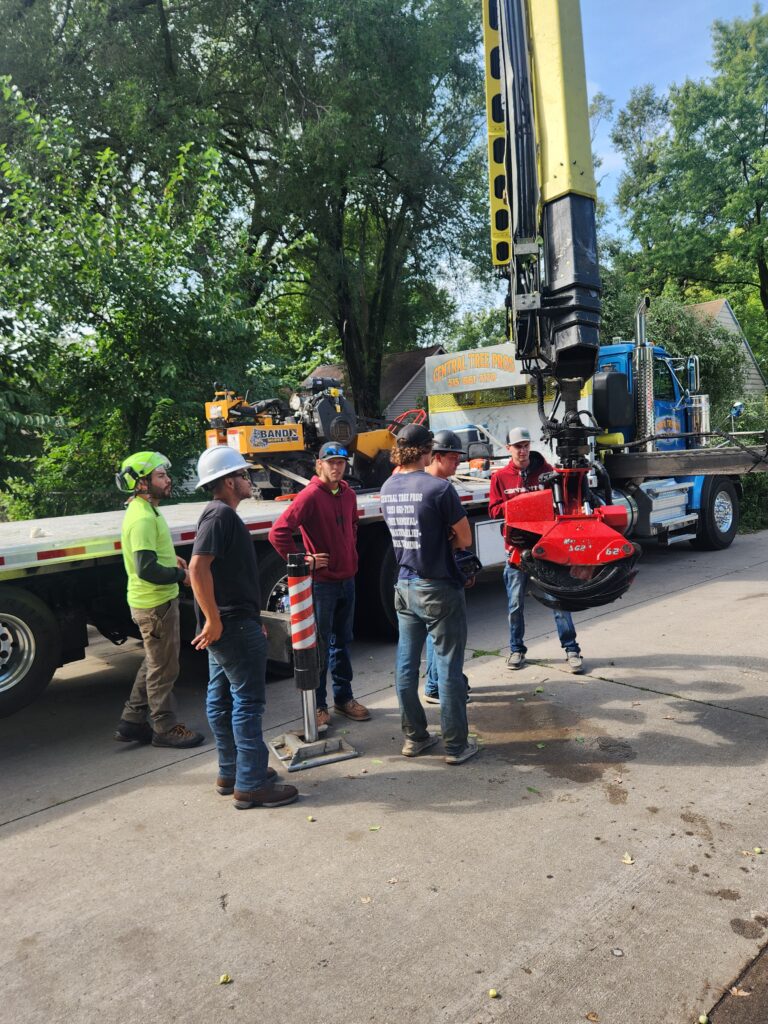
Crane-assisted tree removal gives crews more control when a large, damaged, or hard-to-reach tree cannot be removed safely through conventional methods. For homeowners comparing options with an emergency tree removal company Des Moines has, cranes and grapple saw trucks can be especially useful when trees are over homes, storm-damaged, structurally compromised, or located where there is little room for error.
Central Tree Pros has built much of its Des Moines operation around this type of work. Owner and CEO Zach Miller says the company moved into crane removals after seeing demand for safer and more efficient ways to handle large, dangerous trees. Today, the team uses cranes, grapple saw trucks, specialty lifts, and trained operators for jobs where controlling each section of the tree matters.
What Is Crane-Assisted Tree Removal?
Crane-assisted tree removal uses a crane to support, lift, and move sections of a tree as they are cut. Instead of relying entirely on gravity, ropes, or workers climbing through the canopy, the crew can control large limbs and trunk sections and move them toward a designated landing area.
This approach is especially useful when a mature tree is surrounded by a house, fence, driveway, landscaping, or neighboring property.
The Occupational Safety and Health Administration identifies falling trees and branches, falls, chainsaws, equipment, and energized power lines as major hazards in tree-care work. A crane does not eliminate those hazards, but it can give trained crews more control over how heavy sections are removed.
Crane-assisted tree removal simply means using lifting equipment to support and move tree sections in a controlled way during removal.
How Does a Grapple Saw Truck Work?
A grapple saw truck combines a long boom, a gripping attachment, and a cutting saw so a tree section can be held before it is cut. On suitable properties, that can reduce how often workers need to climb directly into hazardous parts of a tree.
The grapple closes around a limb or trunk section. The saw makes the cut while the equipment is already holding that piece. The operator can then move it away from the home or canopy and lower it into a designated work area.
Zach says Central Tree Pros originally worked with more traditional stick cranes before moving toward grapple saw equipment.
“We were one of the first to come in with grapple saw trucks and really help change the industry,” he said during The Sawdust Sessions.
For Central Tree Pros, the equipment can also improve efficiency by reducing the number of workers who need to be directly beneath or around the tree during certain parts of the job.
When Is a Crane the Safest Option for Removing a Tree?
A crane is most useful when a tree’s size, condition, location, or surroundings make conventional removal harder to control. Trees over houses, storm-damaged trees, large mature trees, and trees with limited drop zones are common examples.
When a Tree Is Over a House
Large branches above a roof leave little room for an uncontrolled drop. A crane may allow crews to secure a section, cut it, and lift it away from the structure.
When a Tree Is Damaged or Unstable
Cracks, splits, decay, broken leaders, or partial uprooting can make a tree more unpredictable. A crane can reduce the need to rely on weakened sections of the tree for climbing or rigging.
When Access Is Limited
Backyards may be surrounded by fences, homes, sheds, pools, or landscaping. If the crane has enough reach and a safe setup location, crews may be able to lift sections over those obstacles.
When the Tree Is Unusually Large
Large limbs and trunk sections can be extremely heavy. Crane assistance can give crews another way to manage those loads instead of relying solely on ropes and manual rigging.
Why Are Storm-Damaged Trees Especially Dangerous?
Storm-damaged trees can be unpredictable because branches, trunks, and roots may already be cracked, twisted, partially supported, or under pressure. Cutting one section can release stored force and cause another section to shift, fall, roll, or spring unexpectedly.
Iowa State University Extension advises homeowners to prioritize large broken branches, split trunks, and damaged sections hanging over homes, driveways, garages, or other structures. It also recommends professional help when climbing, chainsaws, large branches, or trees resting on structures are involved.
Zach describes the risk plainly:
“Trees are not something you want to take on by yourself. They’re very dangerous, unpredictable, and extremely heavy.”
During storm response in St. Louis, the Central Tree Pros crew encountered a group trying to cut a tree off a house with chainsaws. The crew used its crane to secure and remove the tree instead.
The lesson is simple: once a damaged tree is resting on a structure or under tension, the forces acting on it may not be obvious from the ground.
How Can Crane-Assisted Removal Help Protect Property?
Crane-assisted removal can help protect surrounding property by giving crews more control over where heavy tree sections move after they are cut. Instead of allowing a large limb to fall or swing through a tight area, crews may be able to lift it clear of a roof, fence, driveway, or garden.
That does not mean a crane guarantees zero property impact.
Large equipment still needs a safe setup area. Trucks, outriggers, and debris handling can affect lawns or driveways if the site is not planned properly.
A qualified crew should evaluate the entire property, including equipment access, ground conditions, landing areas, landscaping, structures, and overhead hazards.
Central Tree Pros says this property-first approach is part of its customer service philosophy. Miller said the company focuses on addressing avoidable damage before considering the job complete.
Is Crane Removal Always Better Than Traditional Tree Removal?
No. A crane is a specialized tool, not the right answer for every tree. Healthy trees in accessible locations can often be removed through conventional climbing, rigging, aerial lifts, or ground-based methods.
Central Tree Pros performs those removals too.
A front-yard tree with plenty of open space presents a different challenge than a damaged tree leaning over the back half of a house. Using a crane where it adds little benefit can create unnecessary complexity.
Access also matters. Crews must consider ground stability, equipment setup space, road access, power lines, overhead obstacles, and the distance between the crane and tree.
The International Society of Arboriculture emphasizes that tree risk assessment should consider the condition of the tree, the site, possible targets, the likelihood of failure, and the consequences.
The safest method is the one that fits the actual tree and property.
When Should a Damaged Tree Be Removed Instead of Saved?
Removal may be appropriate when structural damage leaves a tree with an unacceptable level of risk that pruning or other mitigation cannot reasonably correct. Major trunk splits, extensive root failure, severe canopy loss, or partial uprooting can all justify a professional evaluation.
Not every damaged tree needs to come down.
A broken limb may simply need proper pruning. Other structural issues may have viable management options.
However, Iowa State University Extension notes that split trunks, extensive trunk damage, major canopy loss, and partial uprooting can make removal the safer choice.
Central Tree Pros focuses on removal rather than cabling. Cabling uses support systems to help manage certain structural weaknesses, but it is not suitable for every tree.
The important question is not simply whether a tree can remain standing. It is whether it can remain at an acceptable level of risk around people and property.
What Should Happen Before Crane-Assisted Removal Begins?
A crane removal should begin with an assessment of the tree, the property, the equipment setup area, and the hazards around the work zone. Crews need a plan for supporting, cutting, moving, and processing each major section.
That assessment may include:
- Tree size and structure
- Decay, cracks, or broken limbs
- Nearby houses and structures
- Crane reach and setup location
- Ground and driveway conditions
- Utility lines
- Traffic and pedestrian exposure
- Landing and debris-processing areas
OSHA also recommends evaluating tree condition and worksite hazards before tree-care operations begin.
Homeowners may not see much of this planning, but it is what makes a complicated removal look controlled once the cutting starts.
What Should Homeowners Look for in a Crane Tree Removal Company?
Homeowners should look for appropriate insurance, trained operators, experienced crews, specialized equipment, and a clear plan for protecting the property. Owning a crane or grapple saw alone does not prove that a contractor is prepared for complicated work near a home.
Miller says Central Tree Pros carries workers’ compensation coverage and $5 million in general liability coverage.
Homeowners should also ask:
- Why is a crane being recommended?
- Where will the equipment be positioned?
- How will the lawn and driveway be protected?
- How will tree sections be controlled?
- Does the estimate include cleanup?
- Is stump grinding included?
- Who will operate the equipment?
Iowa State University Extension recommends checking qualifications, references, professional affiliations, and local requirements when choosing an arborist.
A good contractor should be able to explain the plan clearly before the job begins.
How Much Does Crane-Assisted Tree Removal Cost?
Crane-assisted tree removal does not have one standard price because every job involves a different mix of tree size, access, equipment, labor, and risk. A large tree over a house usually requires a very different plan from a tree standing in an open front yard.
Pricing can depend on:
- Tree height and diameter
- Number and size of major limbs
- Tree condition
- Crane reach
- Structures under the canopy
- Emergency conditions
- Equipment required
- Debris removal
- Stump grinding
- Property access
Using a crane does not automatically make a job more expensive. Specialized equipment can sometimes reduce climbing, rigging, manual handling, and time on difficult removals.
Homeowners should still avoid choosing based on price alone. A low estimate provides little value if the contractor lacks the insurance, experience, or equipment needed to control the job safely.
What Should Homeowners Expect on Removal Day?
A crane-assisted removal usually involves equipment setup, a controlled work zone, planned cuts, mechanical lifting, debris processing, and final cleanup. The exact sequence depends on the tree and equipment.
The crew first positions and stabilizes its equipment. Work areas are established to keep people away from hazards.
The tree is then dismantled in planned sections. With a grapple saw, the machine may grip a limb or trunk before making the cut. Other crane removals may involve workers attaching sections to lifting equipment before cutting.
Each section is moved into a designated area for processing. Branches may be chipped, while larger wood is cut and removed.
Central Tree Pros also offers stump grinding for trees it removes, although the company does not typically perform standalone stump grinding.
Why Has Central Tree Pros Made Crane Removal a Specialty?
Central Tree Pros specializes in crane-assisted removal because the company intentionally built its training, equipment, and crew around difficult trees that require more control. That focus developed as the company moved from basic tree work into increasingly complicated removals around the Des Moines metro.
Miller started mowing lawns in 2014. After HOA customers began requesting tree work, he moved into trimming and smaller removals. Demand for larger, more hazardous removals eventually led the company into crane work.
Central Tree Pros trained with companies outside Iowa, invested in specialized equipment, and later adopted grapple saw trucks. The company now has 14 employees and handles both routine tree work and complex crane removals.
It also responds to major storm damage outside Iowa when needed. Director of Operations Jack Wadden said the team has performed storm work in states including Georgia, Virginia, Florida, and Missouri.
For homeowners dealing with a tree on a house, structural failure, or another urgent situation, choosing an emergency tree removal company Des Moines has to offer should come down to whether that company has the equipment, coverage, experience, and plan to control the actual risk.
Watch the Full Podcast Episode
Watch the full episode of The Sawdust Sessions on YouTube to hear Central Tree Pros owner and CEO Zach Miller and Director of Operations Jack Wadden explain how the company approaches crane removals, grapple saw technology, insurance, storm response, and difficult tree work. The full conversation also covers how Central Tree Pros grew into a crane-equipped Des Moines tree company and why the team focuses on making complex removals as controlled and straightforward as possible for homeowners.
Frequently Asked Questions
Can a Crane Remove a Tree Without Damaging My Lawn?
A crane may reduce some ground activity, but no contractor can guarantee that a lawn will be untouched. Equipment placement, outriggers, debris, soil conditions, and access all affect the property.
Can a Crane Remove a Tree From a Backyard?
Yes, if the crane has enough reach and a safe setup area. Crews must evaluate distance, obstacles, tree weight, and equipment capacity before deciding whether the job is practical.
Is a Grapple Saw Safer Than Sending a Climber Into the Tree?
A grapple saw can reduce the need for workers to enter some hazardous parts of a tree, but it is not safer in every situation. Access, tree condition, utilities, and operator experience still matter.
Can a Crane Remove a Tree That Has Already Fallen on a House?
Yes, cranes can be useful for supporting and moving heavy sections of trees resting on structures. The site still needs to be evaluated for structural, electrical, and load-related hazards first.
Does a Leaning Tree Always Need to Be Removed?
No. Some trees naturally grow at an angle. A new lean, soil movement, root damage, cracks, or storm damage are more concerning and should be evaluated professionally.
Does Every Large Tree Require a Crane?
No. Many large trees can be removed through conventional climbing or rigging when the site and tree condition allow it. A crane is most useful when it solves a specific access, weight, or risk problem.
Should I Cut Up a Storm-Damaged Tree Myself?
Homeowners should avoid work involving large limbs, climbing, trees resting on structures, or heavily damaged wood under tension. Those trees can shift unexpectedly once a cut releases pressure.